Field guide · Sea Point

The Sea Point Window Field Guide

Light, wind and salt on the Atlantic seaboard — a real, sourced walk-through of how to shade an apartment on this stretch of coast, why one product beats another on each elevation, and the honest trade-offs both ways. Free to read, no email required.

Start here

Why a Sea Point window is its own problem

Sea Point is not a suburb of stand-alone houses with garden walls to break the weather. It is a high-rise apartment corridor wedged on a thin shelf between Signal Hill and the Atlantic, and one of Cape Town’s most densely built residential areas.6

Block after block of floor-to-ceiling glass faces Beach Road and the open ocean, most of it on a tight footprint with little spare wall. That geography decides almost everything about how a window here should be dressed: the sun arrives off open water, the wind arrives with nothing to slow it, and the salt arrives every single day. A blind chosen off a shelf for a house up in the Southern Suburbs will not behave the same way on a fourth-floor Beach Road lounge. This guide walks the reasons through, elevation by elevation — then hands you two easy ways forward at the end.

The light here

Where the sun actually comes from

Cape Town sits at latitude 33.97°S,3 which flips the northern-hemisphere rulebook: your north-facing windows are the equator-facing ones that take the useful, low winter sun, while the high summer sun climbs almost overhead.4 But in Sea Point the defining light is not the north — it is the west. The apartments look out over the Atlantic, and the sun sets across that water every evening, swinging from the south-west in December round to the north-west in June.2 For a west-facing flat that means the low, blinding evening sun tracks across the entire ocean-side arc through the year, so the angle a blind has to catch never sits still.

Two things make that western light harder than it looks. First, intensity: Cape Town summer UV routinely reaches the “extreme” band, index 11–13, peaking between 10am and 2pm3 — enough to fade fabrics and floors, not only to dazzle. Second, reflection: bright water throws a second helping of glare up onto the ceiling that a purely top-down blind never fully tames. Signal Hill and Lion’s Head rise directly behind Sea Point to the east,1 so the morning sun climbs from behind the ridge and lands softer; it is the afternoon and evening, off the sea, that does the real work on a Sea Point room.

Elevation by elevation

What each side of the building needs

  • West — the ocean sideThe hardest and most common aspect here, and the one worth spending the specification on. This glass takes the full evening sun, the UV and the reflected glare. The honest goal is to stop heat before it crosses the glass, not after.
  • North — the equator-facing sideHigh summer sun and low, welcome winter sun. You want to reject the summer load without permanently killing the winter warmth — which argues for something adjustable rather than fixed blockout.
  • East — the hill sideSheltered by Signal Hill, the morning light is gentler.1 A lighter sunscreen or a day/night blind is usually enough; full blockout is only for bedrooms that need a late lie-in.
  • SouthLittle direct sun and flat, even light — but on this coast the south side still meets the weather and the wind, so durability and, on any balcony, a genuine wind rating matter more than heat control.
  • Balconies & sliding doors (every aspect)Where Sea Point living actually happens, and where the south-easter is the deciding factor. Anything outdoors has to hold its shape in real wind.
The recommendations — and why

What we’d specify, and what we’d specify against

Three calls that come up on almost every Sea Point measure. Each one says why the pick beats the alternative here, and where the alternative is actually the better, cheaper answer. Tap “Carry into my quote” on any of them and it drops straight into the ballpark and ticks your interest below — no retyping.

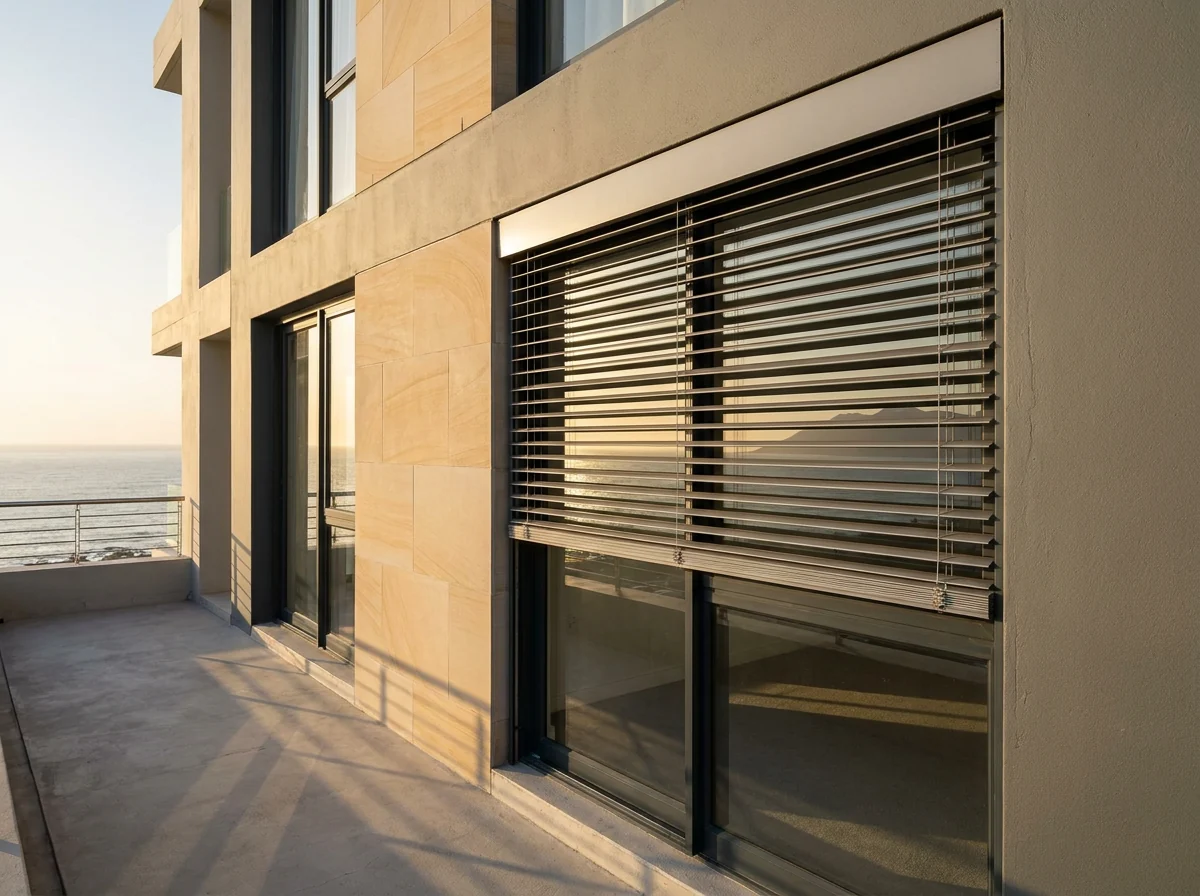
External venetian blinds mounted on the outside of a west-facing Cape Town apartment window, aluminium slats tilted to throw shade across the glass with the ocean beyond

West heat · our pick

External venetians over an interior blockout roller

On a west-facing lounge we’d usually specify external venetians ahead of an interior blockout roller. It’s physics, not fashion: external slats stop the sun outside the glass, so the heat never enters the room, where an interior roller can only block the light after the pane has already absorbed and re-radiated the heat inward. External venetians also tilt, so you hold the view and kill the glare at once.

Honest trade-off: external venetians are a more involved, higher-relative-cost install, they need a facade the body corporate will allow, and their moving parts live in the salt air. Where external isn’t permitted, an interior sunscreen roller plus a cellular blind is the sensible fallback — less effective on pure heat, far simpler to fit and live with.

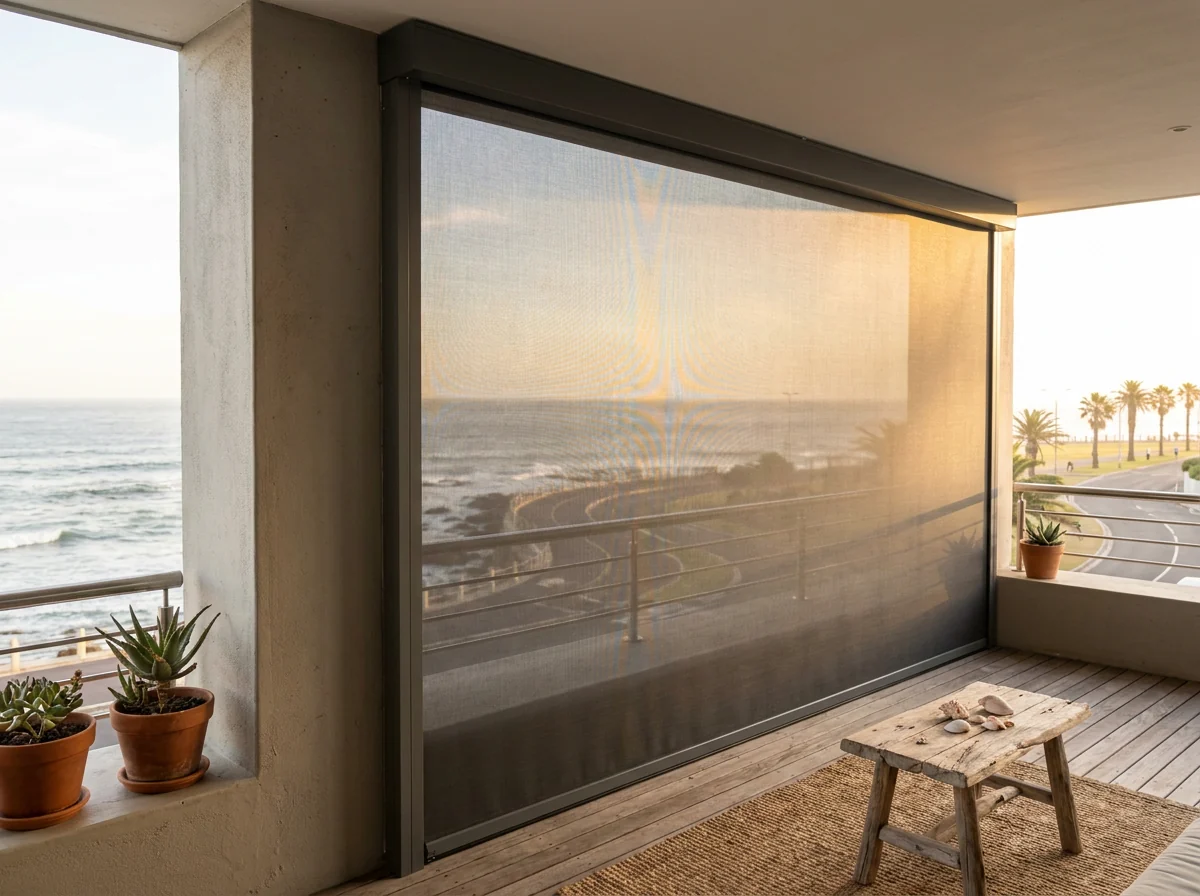
Zip screen with tensioned mesh in zipped side channels enclosing a Sea Point apartment balcony against the wind, ocean and promenade visible through the mesh

Balcony wind · our pick

Zip screens & wind-rated awnings over a loose outdoor blind

For a balcony, a zip screen or a wind-rated folding-arm awning beats a loose outdoor blind or an umbrella, because the south-easter here arrives with nothing to slow it.5 A zip screen runs its mesh in zipped side channels that hold tension in wind that would set an ordinary drop blind flapping; a folding-arm awning with a wind sensor retracts itself before a gust can damage it.

Honest trade-off: a zip screen encloses the balcony edge — some owners love it, some feel it closes in the view — and a sensor-driven awning is a bigger up-front spec than a fixed shade. But a cheap outdoor blind the wind shreds in a season is the false economy this coastline punishes hardest.

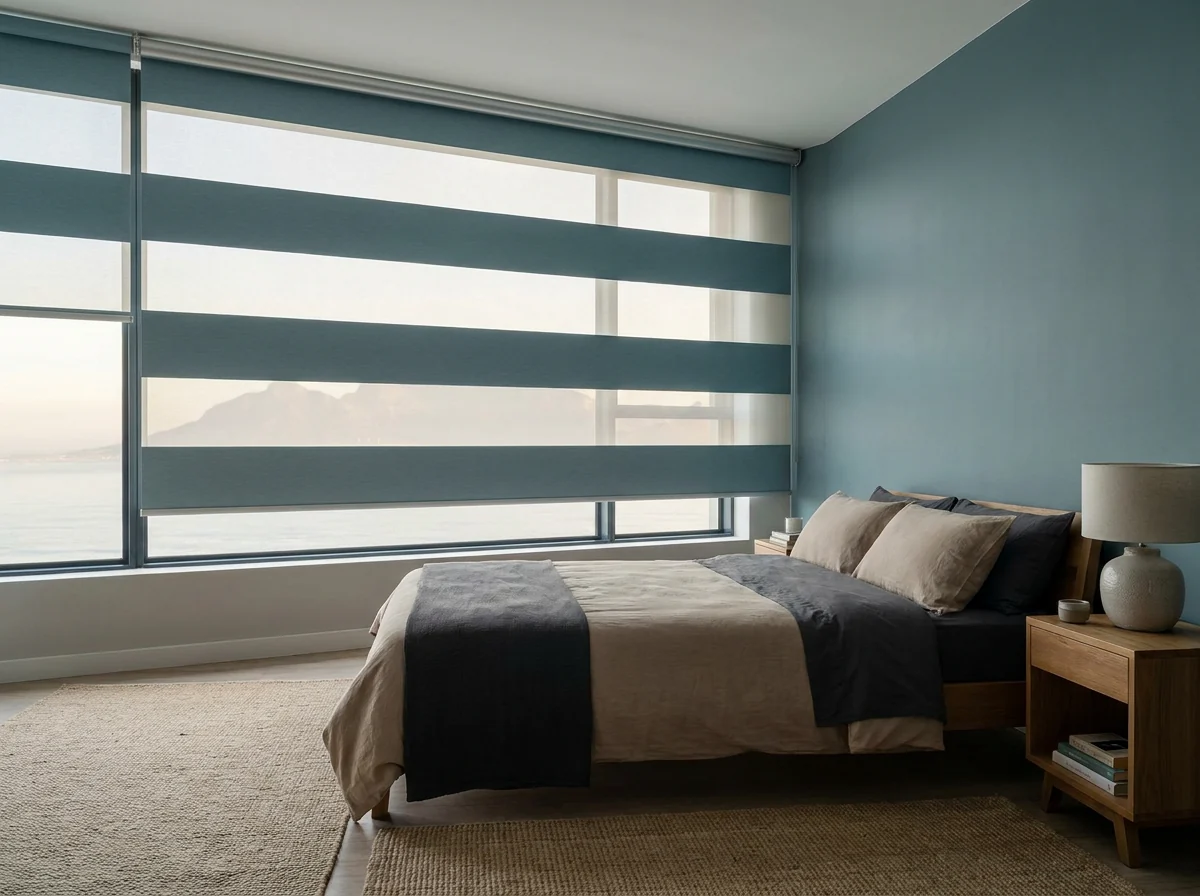
Day/night double-roller blind with alternating sheer and solid horizontal bands over a Sea Point apartment window, striped sea and mountain view showing through

View & privacy · our pick

Day/night blinds over a single sunscreen roller

Where a room has to hold the sea view by day and gain privacy from the promenade at night, a day/night (double-banded) blind earns its place over a single sunscreen roller. Aligned, its bands read almost clear for the view; offset, they close to near-solid once the promenade lights come on — one blind doing both jobs.

Honest trade-off: a single sunscreen roller is cheaper and simpler and, on a window that only ever needs glare control, still the right answer. The day/night premium only pays off where privacy genuinely changes after dark.

Two threads run through all of it. Motorisation stops being a luxury on floor-to-ceiling glass and wide sliding doors — a three-metre chain is a daily chore, and one linked motor moves a whole wall of glass together; rechargeable battery motors retrofit a sectional-title unit without chasing wires into the walls. And salt: whatever goes on the glass here, we specify powder-coated aluminium and sealed cassettes, because within a few hundred metres of the breakers chloride is the thing that ends hardware early.7 (Roller shutters exist as an option too — rigid aluminium slats on the outside of the glass; ours are shading shutters for sun and heat, not security-rated units, which are a different product we can quote on request.)

Estate & heritage notes

The body corporate has a say — plan for it

Almost every Sea Point block is sectional title, which means a body corporate with rules on what may hang on a balcony and what the facade is allowed to look like from the street. Colours, mounting points and anything visible from outside are usually governed, and the older Art Deco buildings along Beach Road8 often carry tighter conservation expectations again.

None of that is a problem — it is simply a step. We specify within your building’s existing guidelines rather than against them, and we flag anything that needs trustee sign-off before you commit to a colour or a bracket. The one thing worth avoiding is ordering an external product for a facade the body corporate was never going to approve.

The honest bit

What we’d still need to check on site

A guide gets you most of the way. A handful of things only a tape measure and a look out of your actual window can settle — and each one changes the specification:

  • Exact reveal depth — whether a blind can sit inside the reveal for a clean line, or has to face-fix.
  • Real wind exposure — a fourth-floor corner balcony and a sheltered second-floor recess on the same block are different jobs.
  • Existing fixings and substrate — what the wall or ceiling will actually take, especially on older concrete.
  • Motor power routing — whether a wired motor is feasible or a rechargeable battery motor is the sane retrofit.
  • Body-corporate constraints — the specific colour and mounting rules for your building.
Two ways forward

Now you know the thinking — here’s the easy part

Recommended

The free expert measure

A consultant comes to you with samples, measures every opening precisely, and settles the on-site questions above — reveal depth, wind exposure, fixings, body-corporate rules. You get a written, itemised, per-window quote. No cost, no obligation.

Book your free measure

We take five or six measure appointments a week along the seaboard, so the diary fills early — booking ahead helps if you need a particular day.

Or, if you’re still gauging it

Your ballpark, in about two minutes

Want a ballpark first? Pop in rough sizes and we’ll send a budget range by the next working day. Not sure how to measure? Leave it — our consultant measures for free and you’ll get exact per-window pricing either way.

Open the ballpark tool
The 2-minute ballpark

Rough sizes in, budget range back

Add a row per window with whatever you know — guesses are fine, this is a ballpark, not a commitment. Pick the product from what you read about above. Hit print to walk the house with it on paper, then send it through with your enquiry and we’ll reply with a budget range by the next working day. Don’t know how to measure? Skip the sizes entirely — the free measure sorts that.

Sea Point Blinds — my window ballpark

POPIA notice: anything you enter here is only used to prepare your budget range and arrange your free consultation call-back, and is never shared beyond that.

The close

Book your free expert measure

The measure and the written per-window quote are both free, with no obligation. Tell us which products caught your eye in the guide — we’ll bring the right samples.

1Free in-home measure — a consultant comes to your apartment.
2Written quote, itemised per window — no surprises.
3Hardware specified for wind and salt from day one.

Just gathering ideas for now? That’s completely fine — pick “still researching” below and we’ll point you back to this guide and the ballpark instead of chasing you.

POPIA notice: the details you share here are used only to arrange your free consultation call-back, and are never shared beyond that.

Sources

Where the facts came from

Every climate, geography and heritage claim in this guide traces to a public source below. Product reasoning is our own, from measuring on this coast.

  1. Sea Point’s position between Signal Hill / Lion’s Head and the Atlantic, and the eastern hill line: mapandfamily.com/sea-point-cape-town and en.wikipedia.org/wiki/Signal_Hill_(Cape_Town).
  2. Seasonal sunset direction (south-west in summer, north-west in winter): sun-direction.com — Cape Town and timeanddate.com/sun/south-africa/cape-town.
  3. Cape Town latitude 33.97°S and “extreme” summer UV (index 11–13, peak 10am–2pm): MDPI Atmosphere 10(10):589 and IRD — Extreme solar UV exposure in Cape Town.
  4. Southern-hemisphere orientation (north = equator-facing; low winter sun, high summer sun): Green Passive Solar — orientation and InterNACHI — building orientation.
  5. The south-easterly “Cape Doctor”, dominant Sept–March and peaking Nov–Feb: en.wikipedia.org/wiki/Cape_Doctor and capetownmagazine.com/cape-doctor.
  6. Salt-air corrosion of aluminium and powder-coating recommended within 5–10 km of the ocean; coastal hardware maintenance: Powder Coating Industries — coastal & marine and Linetec — salt spray & finished aluminium.
  7. Sea Point as a densely built high-rise apartment corridor on the Atlantic seaboard: Seeff — Sea Point area profile and RE/MAX Living — Sea Point.
  8. Art Deco heritage in Cape Town and Sea Point (Beach Road blocks): UCT News — Cape Town’s Art Deco heritage and Culture Connect SA — Art Deco.